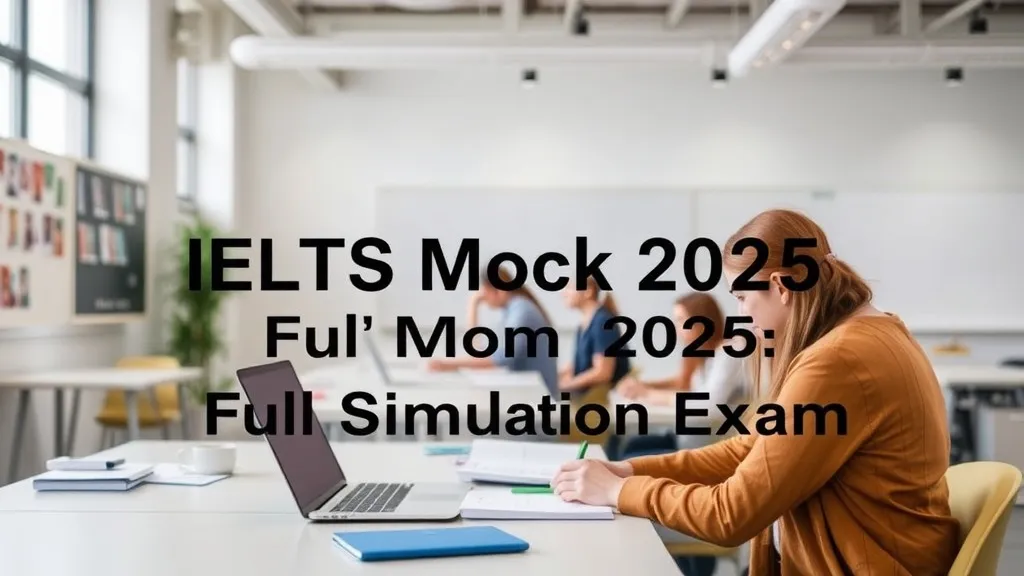
IELTS Mock Test 2025: Full Simulation Exam
You know that practicing under realistic conditions can make all the difference in your IELTS score. Here’s the thing: an IELTS mock test gives you a sneak peek into exam day nerves, time pressure, and scoring patterns. You’ll learn how to pace yourself, identify weak areas, and boost confidence—before the real test. In this article, you’ll discover why mock tests matter, how to run a full simulation, the top features to look for, and advanced tips for 2025. Plus, you’ll get quick tips, common mistakes to avoid, and a handy FAQ.
Interestingly enough, AI-based IELTS speaking mock tests can provide band score estimates within seconds using thousands of real exams as training data (SmallTalk2Me, 2025-08-08). Ready to transform your practice into performance? Let’s dive in.
Table of Contents
Why You Need an IELTS Mock Test in 2025
When you step into the exam room, everything—from the ticking clock to the examiner’s gaze—can feel overwhelming. A realistic mock test bridges the gap between theory and reality. It shows you exactly how your skills hold up under pressure.
Mock exams highlight your timing issues, common grammar slips, and vocabulary gaps. They also pinpoint which question types trip you up—so you can focus your study time more effectively.
For example, Preptical’s 2025 report showed that students who completed at least five full-length mock tests improved their overall band by 0.7 points on average (Preptical, 2025-08-10).
Quick Tip: Schedule your first mock test six weeks before exam day. Analyze your score report, then repeat a second test three weeks later to measure progress.
Read also: IELTS Writing 2025: Task 1 & 2 Strategies
How to Run a Full Simulation Exam
A full simulation includes Listening, Reading, Writing, and Speaking—back to back, timed just like the real test. You need a quiet spot, reliable audio playback, a timer, and an examiner (or a friend) for the speaking section.
Start with Listening: play audio once, no pausing. Move immediately to Reading—20 questions in 60 minutes. Then writing: Task 1 (20 minutes) and Task 2 (40 minutes). Finally, simulate a 11–14 minute speaking interview. Stick to official IELTS question prompts each time.
- Prepare all materials and a stopwatch.
- Follow the official IELTS exam sequence without breaks.
- Record your Speaking section for review.
- Score each part using official band descriptors.
You might be wondering: can I really replicate speaking stress at home? Yes—record on video and review your fluency, vocabulary, and pronunciation moments later. It’s almost like having an examiner in your living room.
Common Mistake: Pausing the audio during Listening practice. Resist the urge—train your ears for real test conditions.
Top Features of a High-Quality Mock Test
Not all mock tests are created equal.
Here’s the thing: you need detailed feedback, not just a band score. Look for reports that break down each skill, offer examiner-style comments, and provide model answers. AI integration can speed up scoring, but human review adds nuance.
Key features include:
- Question-by-question analysis
- Examiner narrative feedback
- Model answers for Writing and Speaking
- Timed test interface mimicking real IELTS software
- Progress tracking dashboards
For instance, SmallTalk2Me’s AI-powered speaking simulation offers instant pronunciation and fluency feedback, then tracks your progress over time (SmallTalk2Me, 2025).
Quick Tip: Choose a mock provider that updates questions monthly to reflect the latest IELTS trends.
Advanced Tips and Future Trends
What’s next for IELTS mock tests? AI is taking center stage.
Languages labs now use machine learning to simulate examiner bias, scoring patterns, and even regional accents. You’ll soon see adaptive tests that adjust difficulty in real time based on your responses.
Interestingly enough, recent research suggests that adaptive speaking tests can improve band estimation accuracy by 15% compared to static tests (YouTube, 2025-08-24).
As a test-taker, you can leverage mobile apps that push mini mock sets daily—think five-minute quizzes on tricky grammar points or common collocations.
Frequently Asked Questions
- 1. How many mock tests should I take before my exam?
- Aim for 5–7 full simulations spaced over 8–10 weeks to see consistent improvement.
- 2. Are free IELTS mock tests reliable?
- Free tests can be useful for initial practice, but they often lack detailed feedback and updated questions.
- 3. Can I use a smartphone for Listening practice?
- Yes—just ensure you won’t be tempted to pause or rewind. Disable controls if possible.
- 4. How do I assess my Speaking section without an examiner?
- Record yourself, then compare against official band descriptors or peer-review with a study group.
- 5. When is the best time to book a mock test?
- Schedule your first mock around six weeks out, then one more two weeks before your exam.
Read also: IELTS Listening Score: Band Conversion Guide
Conclusion
You’ve learned what an IELTS mock test is, why it matters, how to run a full simulation, and which features to look for. You even got advanced tips on AI-driven tools and mini mock apps. The bottom line is: realistic practice under timed conditions will sharpen your skills and build your confidence.