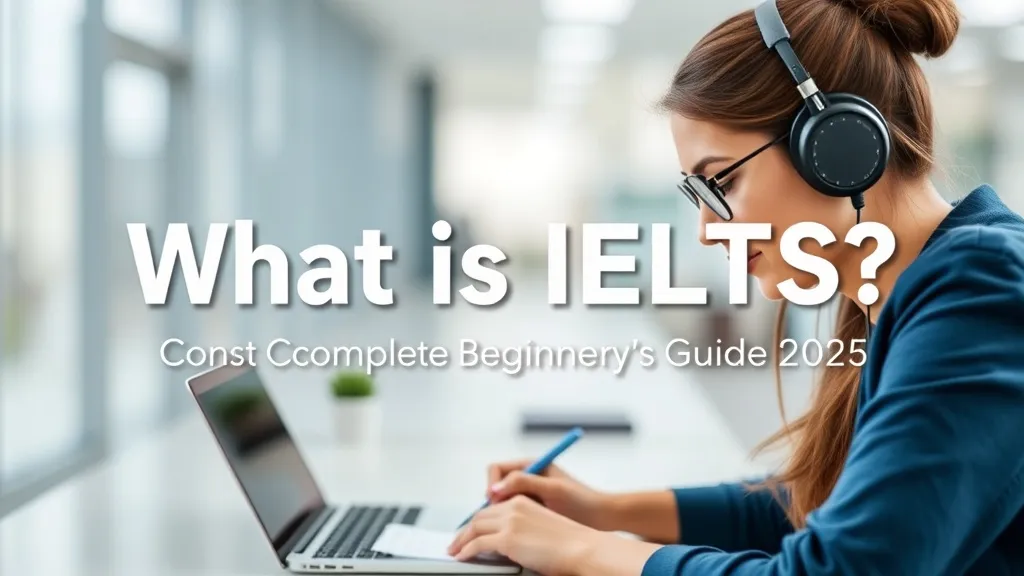
What is IELTS? Complete Beginner’s Guide 2025
You might be wondering what IELTS is. And for good reason—over 4 million candidates take the International English Language Testing System every year as of 2025 (Shiksha). In this guide, you’ll learn exactly what IELTS is, why it matters, and how to tackle the test like a pro. By the end, you’ll know the format, the scoring, and key tips to boost your band score. Ready to demystify IELTS? Let’s dive in.
Table of Contents
- What is IELTS? Definition and Purpose of IELTS
- IELTS Test Versions: Academic vs General Training
- IELTS Test Format and Timing
- Scoring System Explained
- Who Needs IELTS and Why It Matters
- Registration Process and Test Dates
- Preparation Tips and Resources
- Common Mistakes to Avoid
- Future Trends and Changes in IELTS
- FAQ
- Conclusion
What is IELTS? Definition and Purpose of IELTS
Here’s the thing: IELTS stands for International English Language Testing System. It measures English proficiency for non-native speakers aiming to study, work, or migrate abroad. Created by experts at the British Council, IDP: IELTS Australia, and Cambridge Assessment English, it’s recognized in over 12,500 organizations worldwide.
Why does it matter? Because your score can unlock a university offer, a visa, or even a job contract. Simply put, IELTS is your ticket to global opportunities.
“IELTS offers a fair and reliable assessment of English skills across Listening, Reading, Writing, and Speaking.” — Cambridge Assessment English
Actionable takeaway: Check if your target university or immigration program accepts IELTS by visiting official sites or Wikipedia.
Read also: IELTS Listening Score: Band Conversion Guide
IELTS Test Versions: Academic vs General Training
You might be asking: which version is right for you? There are two main types:
- Academic: Ideal for university or professional registration.
- General Training: Suited for work experience or migration.
Both versions share Listening and Speaking sections but differ in Reading and Writing content. For instance, Academic Writing Task 1 asks for a graph description, whereas General Training Task 1 involves a letter.
IELTS Test Format and Timing
Let me explain the schedule. The test lasts about 2 hours and 45 minutes:
- Listening: 30 minutes + 10 minutes to transfer answers
- Reading: 60 minutes
- Writing: 60 minutes
- Speaking: 11–14 minutes (may be on a different day)
Interestingly enough, you can take IELTS up to three times a day—computer-based—or 48 times a year on paper-based tests. That’s flexibility at its best.
Example: Sarah booked a mid-week computer-based test at her local center and finished all sections in one day, freeing up her weekend.
Scoring System Explained
Have you ever wondered how band scores work? Bands range from 1 (non-user) to 9 (expert user). Each section is scored independently, then averaged for an overall band.
| Band | Description |
|---|---|
| 9 | Expert user |
| 7–8 | Good to very good user |
| 5–6 | Modest to competent user |
| 1–4 | Limited to extremely limited user |
In other words, aim for at least a 7.0 overall if you’re applying to top universities. Visa programs sometimes require minimum scores in each skill—so balance is key.
“Balanced proficiency across all four skills boosts immigration success rates by 20%.” — IDP: IELTS Australia
Actionable takeaway: Analyze your weak sections and focus practice on them.
Who Needs IELTS and Why It Matters
Wondering if you need IELTS? The truth is, it’s essential for:
- Undergraduate and graduate studies abroad
- Professional registration (e.g., nursing, teaching)
- Immigration to English-speaking countries
For example, Canada’s Express Entry requires a minimum of 6.0 in each band. Without IELTS, your application could stall.
Actionable takeaway: Review specific immigration or university requirements before registering.
Read also: IELTS Advantage: Premium Preparation Platform 2025
Registration Process and Test Dates
Registration is straightforward:
- Visit the official IELTS website or local test center.
- Choose your preferred test version, date, and mode.
- Upload identification and pay the fee (around USD 245–USD 260).
- Receive confirmation and study materials.
Most centers offer dates year-round, with paper-based dates set 48 times annually. Computer-based slots can fill up fast.
Actionable takeaway: Register at least six weeks before your intended start date.
Preparation Tips and Resources
Let’s get real—preparation makes or breaks your score. Here’s what works:
- Official IELTS apps and practice tests
- Online courses with mock interviews
- Study groups or speaking partners
You can explore IELTS preparation resources for guided practice. Also check out apps that simulate test conditions.
Actionable takeaway: Set a study schedule—daily short sessions beat occasional marathon reviews.
Common Mistakes to Avoid
Here’s a small list of pitfalls:
- Ignoring time limits in mock tests
- Overusing complex vocabulary incorrectly
- Skipping practice for individual skills
- Not reviewing writing task responses
Future Trends and Changes in IELTS
Simply put, IELTS remains stable in 2025. While competitors like PTE revamped their formats, IELTS stuck to trusted structures. Human scoring persists in Speaking and Writing for fairness.
Also, more visa programs now require skill-specific minima. Digital test options continue to expand, with local centers investing in computer labs.
Actionable takeaway: Stay updated via official channels for any late-breaking changes.
FAQ
- What is the cost of IELTS?
- Fees typically range from USD 245–USD 260 depending on location.
- How long are IELTS scores valid?
- Scores are valid for two years from the test date.
- Can I retake IELTS?
- Yes. You can retake as many times as you like, paying the fee each time.
- Is there a pass or fail?
- No. You receive a band score. Institutions set their own cut-offs.
Conclusion
In summary, IELTS measures your English skills across four areas and opens doors to education, work, and migration. You’ve learned its purpose, versions, format, scoring, and practical steps to prepare. Now it’s your turn: register early, create a balanced study plan, and focus on weak spots. Finally, take a full mock test under timed conditions to build confidence. Good luck on your IELTS journey—here’s to your success with what is IELTS guiding you every step of the way!