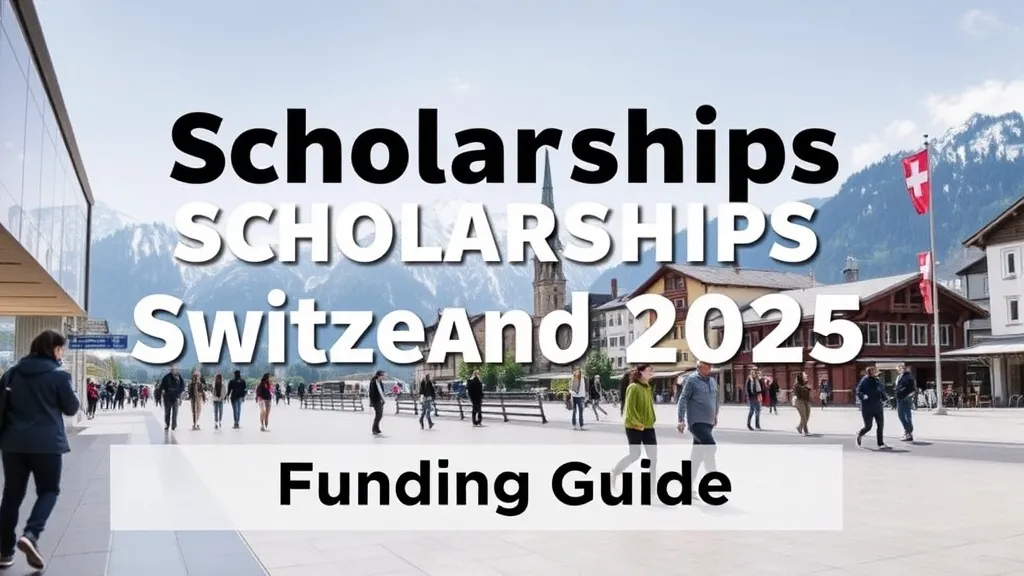
Scholarships Switzerland 2025: Funding Guide
Finding reliable information on scholarships to study in Switzerland can feel like searching for a needle in a haystack. You’re not alone if you’ve spent hours scouring the web. The truth is, Switzerland offers a wealth of funding opportunities—from government-backed grants to private foundations. In this guide, you’ll discover the top scholarships available in 2025, learn step-by-step application tips, and get insider advice to boost your chances.
Interestingly enough, over 180 nations participate in the Swiss Government Excellence Scholarships program each year (Swiss Government). That’s a huge pool of applicants—and you could be one of the selected few.
This article covers:
- Overview of major Swiss scholarships
- Eligibility and benefits for masters, PhD, postdoc
- Top tips and common mistakes to avoid
- FAQs and next steps
Table of Contents
Swiss Government Excellence Scholarships 2025
Ever wondered what makes a scholarship truly “excellence”?
These fully funded awards cover tuition, a monthly stipend (~CHF 1,920), health insurance, airfare and housing allowance. You’ll be part of a selective cohort—each year, about 300 scholars are chosen from 180+ countries (Grab Scholarships).
Why it matters: This scholarship lifts financial burdens so you can focus on research and studies.
Detailed benefits:
- Monthly stipend: CHF 1,920
- Tuition exemption
- Health insurance coverage
- Airfare allowance
Example: A PhD candidate from India received full support and completed her research in renewable energy at ETH Zurich (ETH Zurich), publishing three papers in top journals.
“The Swiss Government Excellence Scholarship transformed my career,” says Dr. Meera Sharma, 2024 alumna.
Actionable takeaway: Prepare transcripts, two recommendation letters, and a research proposal by October 27, 2025.
SNSF Professorial Fellowships 2025
Looking to jumpstart a research career? The SNSF Professorial Fellowships offer up to CHF 1 million for research costs plus a full assistant professor salary.
Context: Early-career researchers can lead independent projects for up to five years (non-renewable).
How it works:
- Submit project outline and CV
- Secure a host institution’s endorsement
- Undergo peer review by SNSF panels
Real example: A postdoc in molecular biology gained CHF 800,000 in funding and now leads a team at the University of Geneva. You might be wondering—what’s the catch? Age and qualification limits apply, so check deadlines early.
Expert data: SNSF review success rate hovers around 20%—prepare a standout proposal (Opportunities for Youth).
Actionable takeaway: Network with potential hosts six months before the call opens in January 2025.
University-Specific Scholarships
Is one-size-fits-all funding not enough? Many Swiss cantonal universities and federal institutes offer their own awards.
Here are some highlights:
- ETH Excellence Scholarship: CHF 12,000 grant plus student assistant job.
- EPFL Laureate Fellowship: Full tuition waiver and CHF 28,000 living stipend.
- University of Geneva Master’s Grants: CHF 10,000 one-time payment.
Case study: A master’s student from Brazil received the EPFL Laureate Fellowship, enabling her to work on AI ethics without tuition worries.
Quick Tip: Check each university’s scholarship portal in January–February, as deadlines vary.
Private and Foundation Scholarships
Besides public funding, private foundations fill many niches. Who can apply?
Context: Foundations often target specific fields (arts, humanities, STEM) or nationalities.
Popular programs include:
- Stiftung Mercator Switzerland: Humanities and social sciences focus, up to CHF 45,000.
- Pro Helvetia Scholarships: Art and culture projects, CHF 5,000–15,000.
- Marie Heim-Vögtlin Grants: Women in science, CHF 50,000 for research costs.
Expert quote: “Foundation grants can be less competitive than federal awards,” notes Dr. Claudia Keller, funding advisor.
Actionable takeaway: Identify 2–3 foundations aligned with your profile and start applications in March 2025.
Application Tips and Common Mistakes
Feeling overwhelmed? You’re in good company.
Common mistake: Submitting generic proposals. Tailor each application to the scholarship’s objectives.
Let me explain—review every requirement twice, especially word counts.
Actionable steps:
- Read the call document fully
- Draft proposal and revise with peers
- Get language feedback from a native speaker
Pro tip: Use a spreadsheet to track deadlines, documents, and contacts.
FAQ
- What is the success rate for Swiss Government Excellence Scholarships?
- Roughly 1 in 20 applicants (EURAXESS).
- Can I apply for multiple grants simultaneously?
- Yes, but check conflict-of-interest rules. Some programs restrict dual applications.
- Are online courses eligible for these scholarships?
- Generally no—most require in-person enrollment at Swiss higher-education institutions.
Conclusion
To sum up, scholarships to study in Switzerland offer unparalleled chances to advance your education and research without financial strain. From the flagship Swiss Government Excellence Scholarships to targeted foundation grants, there’s funding for every level: master’s, PhD, postdoc, and professorial fellowships.
Next steps:
- Shortlist 3 scholarships matching your profile
- Prepare tailored documents and research proposals
- Submit applications before deadlines in late 2025
The bottom line is that careful planning and bespoke proposals make all the difference. Your journey toward studying in Switzerland starts now—go ahead, seize the opportunity!