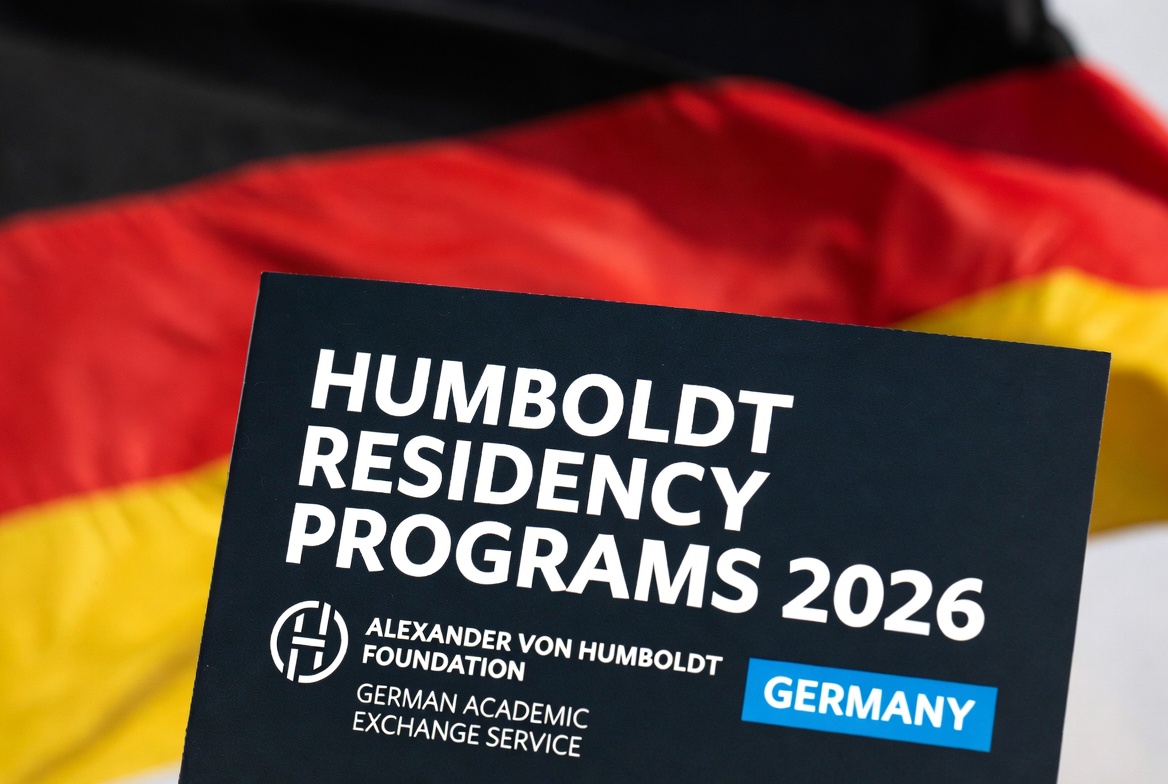
Apply now for the fully funded Humboldt Residency Programme 2026 in Germany. Monthly stipend, free accommodation, travel covered. Deadline: December 15, 2025.
Table of Contents
- Your Democratic Ideas Could Change the World. Here’s How Germany Will Fund It.
- Quick Facts: Humboldt Residency Programme 2026
- What Makes This Opportunity Different?
- It’s Not Just About Research—It’s About Impact
- Financial Benefits: What’s Fully Funded Really Means
- Direct Financial Support
- Travel & Logistics
- Accommodation
- Family Support
- Professional Development Budget
- Who Can Apply? Eligibility Criteria Explained
- Category 1: Humboldt Foundation Alumni (3 spots)
- Category 2: Early Career Researchers (3 spots)
- Category 3: Civil Society Innovators (5 spots)
- The Connection That Matters Most
- Required Documents: Your Application Checklist
- 1. Curriculum Vitae (CV)
- 2. Introduction Video (60 Seconds)
- 3. Online Application Form
- How to Apply: Step-by-Step Guide
- Step 1: Research the Theme Deeply (Today – December 5)
- Step 2: Identify Your Angle (December 6-8)
- Step 3: Create Your Video (December 9-10)
- Step 4: Craft Your CV (December 11-12)
- Step 5: Complete Online Application (December 13-14)
- Step 6: Confirmation & Wait (December 15 onward)
- Common Application Mistakes to Avoid
- Mistake #1: Generic Connection to Theme
- Mistake #2: Academic Jargon Overload
- Mistake #3: Forgetting the Transdisciplinary Element
- Mistake #4: Weak Video
- Mistake #5: Last-Minute Rush
- Program Timeline: What to Expect
- June 2026
- August 2026
- September – October 2026
- October 27, 2026
- FAQ: Your Questions Answered
- Can I apply if I’m currently doing my PhD?
- I’m a journalist with no academic affiliation. Am I eligible?
- Will my family be supported if they come with me?
- What if my connection to “democracy” isn’t obvious?
- Is there an age limit?
- Can I apply from any country?
- What happens if I’m selected but can’t secure a visa?
- How competitive is selection?
- Why This Program Matters in 2026
- Final Application Checklist
- The Bottom Line
- Related Opportunities
Your Democratic Ideas Could Change the World. Here’s How Germany Will Fund It.
Picture this: Six weeks in Berlin and Brandenburg, working alongside brilliant minds from across the globe, designing the future of democratic participation. No tuition fees. No accommodation costs. Your travel paid. A monthly stipend in your pocket.
The Humboldt Residency Programme 2026 brings together researchers, artists, journalists, and civil society innovators to address one of our generation’s most pressing challenges: strengthening democracy through meaningful citizen participation. This isn’t your typical academic fellowship. It’s a transdisciplinary experiment where your expertise in political science, journalism, community organizing, or creative arts becomes part of something bigger.
The deadline is December 15, 2025—just 12 days away. Are you ready?
Quick Facts: Humboldt Residency Programme 2026
| Category | Details |
|---|---|
| Host Organization | Alexander von Humboldt Foundation, Germany |
| Program Type | Fully Funded Residency Fellowship |
| Theme | Democracy 2.26: Designing Political Participation |
| Duration | 6 weeks in-person (Aug 3 – Sep 11, 2026) + remote work |
| Location | Schloss Wiepersdorf & Berlin, Germany |
| Coverage | Monthly allowance, travel, accommodation, family support, visa fees |
| Open to | International researchers, civil society actors, journalists, artists |
| Application Deadline | December 15, 2025 |
| Decision Notification | Mid-February 2026 |
What Makes This Opportunity Different?
It’s Not Just About Research—It’s About Impact
The program focuses on “Democracy 2.26: Designing Political Participation,” examining how democracies can adapt to regional demands and increase accessibility for all citizens. You won’t sit in a library reading papers. You’ll design real-world participation formats, run public experiments, and communicate your findings through media appearances, workshops, and creative outputs.
Think of it as an innovation lab for democracy itself.
Advisor’s Pro Tip: The Humboldt Foundation explicitly welcomes “innovative or creative approaches.” Your unconventional background—whether you’re a documentary filmmaker, community organizer, or data artist—is an asset, not a limitation.
Financial Benefits: What’s Fully Funded Really Means
Here’s exactly what the Alexander von Humboldt Foundation covers:
Direct Financial Support
- Monthly allowance throughout the six-week residency period
- Covers living expenses in one of Europe’s most vibrant (yet surprisingly affordable) cities
Travel & Logistics
- Travel allowance for trips to and from Germany
- No matter where you’re flying from—Lagos, New Delhi, Buenos Aires—your flight is covered
- Zero visa fees (stated in the visa invitation letter)
Accommodation
- Two weeks at the historic Schloss Wiepersdorf Cultural Foundation
- Four weeks in a modern aparthotel in Berlin
- All meals and utilities included
Family Support
- Suitable family accommodation for participants traveling with dependent family members
- Childcare assistance arranged by the Foundation
- This is rare. Most residencies expect you to leave your family behind.
Professional Development Budget
- Funding to organize public events, workshops, or creative outputs
- Resources for producing blogs, videos, or publications from your work
Real Talk: International fellows in Germany typically need €1,200-€1,500 monthly for living expenses. Your stipend plus free housing means you can focus entirely on your work without financial stress.
[Internal Link: Germany Research Fellowships] | [Internal Link: Fully Funded Opportunities for Doctoral Students]
Who Can Apply? Eligibility Criteria Explained
The Humboldt Residency Programme seeks 12 participants from three distinct categories:
Category 1: Humboldt Foundation Alumni (3 spots)
You’re eligible if:
- You’ve previously received any Humboldt fellowship or prize
- You currently hold an academic position
- You’re not based in Germany
- You’re not involved in another Humboldt programme in August 2026
Category 2: Early Career Researchers (3 spots)
Perfect for you if:
- You’re completing your PhD or finished it less than 4 years ago (as of August 2026)
- You hold an academic position outside Germany
- Your research connects to democratic participation, political science, or related fields
Note: “Academic position” includes postdoctoral roles, lecturerships, or research positions—not just tenured faculty.
Category 3: Civil Society Innovators (5 spots)
This is where the program gets exciting. They seek individuals from civil society, journalism, arts, or social entrepreneurship who don’t currently hold academic positions.
Are you:
- An investigative journalist covering political movements?
- A community organizer working on grassroots democracy?
- A documentary filmmaker exploring citizen participation?
- A social entrepreneur building civic tech platforms?
- An artist creating work about representation and voice?
Then this fellowship is designed for you.
The Connection That Matters Most
All applicants must demonstrate a relevant connection to the annual theme through their work or engagement, with explicit invitation to those with innovative approaches.
The Foundation doesn’t want traditional academics reciting theory. They want practitioners, experimenters, and creative thinkers who understand democracy from the ground up.
Advisor’s Pro Tip: When writing your application, focus less on credentials and more on specific projects or interventions you’ve designed. Have you organized a citizens’ assembly? Created a participatory budgeting tool? Documented a grassroots movement? Lead with that.
[Internal Link: Civil Society Fellowships] | [Internal Link: Journalism Opportunities in Europe]
Required Documents: Your Application Checklist
Getting this right matters. The application process is straightforward but selective.
1. Curriculum Vitae (CV)
- Maximum 3 pages in PDF format
- Focus on relevant experience, not every job you’ve ever had
- Highlight projects related to democracy, participation, or civic engagement
- Include links to published work, exhibitions, campaigns, or media coverage
2. Introduction Video (60 Seconds)
This is where personality counts. The Foundation wants you to introduce yourself and explain why you’re the right person for the programme, encouraging demonstration of personality and creativity.
Technical requirements:
- Record in landscape format (16:9)
- Use your smartphone—production quality doesn’t matter
- Choose good lighting and a quiet location
- Upload to Smash (https://fromsmash.com/) and include the link in your application
What to say:
- Who you are in one sentence
- Your connection to democratic participation (be specific!)
- What unique perspective or approach you bring
- Why this cohort needs your voice
What NOT to do:
- Don’t read from a script
- Don’t use jargon or academic language
- Don’t apologize for your background
Insider Secret: Previous successful applicants treated the video like a conversation with a curious friend, not a formal presentation. Be authentic.
3. Online Application Form
Complete the form at the official Humboldt Foundation application portal.
Important: You can only submit after uploading both your CV and video.
How to Apply: Step-by-Step Guide
Step 1: Research the Theme Deeply (Today – December 5)
The 2026 focus examines subtopics including political legitimacy, deliberative democracy models, representation of minorities, and digital-age participation.
Read current debates about:
- Citizens’ councils and participatory budgeting
- Digital disinformation and echo chambers
- Minority representation in decision-making
- Trust in democratic institutions
Step 2: Identify Your Angle (December 6-8)
Ask yourself:
- What specific aspect of political participation do I understand deeply?
- What have I done (not just studied) in this space?
- What innovative format or approach can I bring?
Step 3: Create Your Video (December 9-10)
Script key points, then film naturally. Record 3-4 takes and choose the best one. Upload to Smash and test the link.
Step 4: Craft Your CV (December 11-12)
Use clear section headers: Experience, Projects, Publications, Skills. Quantify impact where possible (“organized 3 citizens’ assemblies reaching 500 participants” beats “experience in civic engagement”).
Step 5: Complete Online Application (December 13-14)
Create your account at “My Humboldt” if you don’t have one. Fill out all fields carefully. Upload documents. Submit.
Step 6: Confirmation & Wait (December 15 onward)
You’ll receive immediate email confirmation. The selection committee meets in early February. Expect notification by mid-February 2026.
Deadline: December 15, 2025 at 11:59 PM CET
External Link: Official Humboldt Application Portal
Common Application Mistakes to Avoid
Mistake #1: Generic Connection to Theme
❌ “I’m interested in democracy and participation.”
✅ “I designed and ran a participatory budgeting pilot in three marginalized neighborhoods, engaging 200 residents who’d never voted.”
Mistake #2: Academic Jargon Overload
This program values clarity and accessibility. If a high school student can’t understand your work description, simplify it.
Mistake #3: Forgetting the Transdisciplinary Element
The power of this residency is collaboration across sectors. Your application should show you can work with academics, artists, and activists equally well.
Mistake #4: Weak Video
A stiff, overly formal video kills your chances. The Foundation wants to see the human who’ll contribute to daily collaborative work sessions.
Mistake #5: Last-Minute Rush
Applications submitted December 14 at 11:45 PM rarely showcase your best work. Start now.
Advisor’s Pro Tip: Have someone from a different field read your materials. If they don’t immediately understand why your work matters for democracy, revise.
Program Timeline: What to Expect
June 2026
June 23: Virtual kick-off meeting
Get to know your cohort, clarify expectations, and begin preliminary readings.
August 2026
August 3-14: Two-week residency at Schloss Wiepersdorf
Historic castle setting in Brandenburg. Intensive work sessions, team building, initial project framing.
August 14 – September 11: Four-week residency in Berlin
Participants meet daily in shared working spaces, gaining time and freedom to understand each other’s work, build transdisciplinary bridges, and connect with Berlin-based stakeholders.
September – October 2026
Remote collaboration to finalize outputs (workshops, publications, media pieces, exhibitions).
October 27, 2026
Virtual wrap-up event celebrating outcomes and impact.
Critical Note: In-person participation from August 3 to September 11, 2026 is mandatory. You cannot participate remotely during this period.
[Internal Link: Research Opportunities in Europe] | [Internal Link: Short-Term Academic Fellowships]
FAQ: Your Questions Answered
Can I apply if I’m currently doing my PhD?
Yes! The program accepts researchers in the final stages of their PhD. If you’re defending in 2026 or recently completed, you’re eligible.
I’m a journalist with no academic affiliation. Am I eligible?
Absolutely. Five spots are specifically reserved for civil society, journalism, arts, or social entrepreneurship professionals without academic positions. Your professional experience is what matters.
Will my family be supported if they come with me?
Yes, the Foundation provides suitable family accommodation and helps arrange childcare for participants traveling with dependent family members. This is explicitly covered.
What if my connection to “democracy” isn’t obvious?
Think broadly. Are you working on:
- Community organizing or grassroots movements?
- Media literacy and combating disinformation?
- Inclusive design or accessibility?
- Cultural identity and representation?
- Economic justice or participatory resource allocation?
These all connect to democratic participation. Frame your work accordingly.
Is there an age limit?
No explicit age limit. However, early career researchers must have completed their PhD less than four years ago, which creates a practical age range for that category. Civil society participants have no such restriction.
Can I apply from any country?
Yes! The program is open internationally. You just cannot be currently based in Germany.
What happens if I’m selected but can’t secure a visa?
Participants will not be charged visa fees, as specified in the Foundation’s visa invitation letter. The Foundation provides official documentation that significantly aids the visa process.
How competitive is selection?
The Foundation doesn’t publish acceptance rates, but with only 11 open spots (the 12th is the creative lead) and global applicants, assume high selectivity. Quality over quantity in your application.
Alexander von Humboldt Foundation Homepage
Why This Program Matters in 2026
Democracy is under strain globally. Populist movements challenge core democratic values, fueled by distrust in institutions and increasing distance from democratic processes among certain social groups.
Traditional voting isn’t enough. Citizens—especially marginalized communities—need new ways to participate in decisions that affect their lives. This residency isn’t just academic exploration. It’s about prototyping those new ways.
Your work could influence:
- Policy frameworks in your home country
- International development programs
- Civil society strategies
- Academic discourse on democratic innovation
The Humboldt Foundation’s credibility means doors open. Alumni have gone on to advise governments, lead NGOs, and shape public discourse.
Real Impact Story: The 2023 cohort, focused on resource sustainability, created a practical handbook for “choice architecture”—influencing how citizens make decisions about environmental impact. Their work reached policymakers across three continents.
[Internal Link: International Development Fellowships] | [Internal Link: Policy Research Opportunities]
Final Application Checklist
Before you hit submit:
- [ ] CV is exactly 3 pages, PDF format
- [ ] Video is 60 seconds or less, landscape format
- [ ] Video link from Smash works (test it!)
- [ ] You’ve clearly explained your connection to democratic participation
- [ ] Your unique perspective or approach is obvious
- [ ] All online form fields are complete
- [ ] You’ve proofread everything (typos matter)
- [ ] Application submitted before December 15, 2025, 11:59 PM CET
Still have questions? Email [email protected] or visit the official FAQ document.
The Bottom Line
You have 12 days to apply for a fully funded, career-defining opportunity that combines intellectual rigor, creative experimentation, and real-world impact.
The Humboldt Residency Programme 2026 isn’t looking for perfect scholars. It’s looking for people who understand democracy from lived experience, who see problems others miss, and who can imagine solutions that don’t yet exist.
If that sounds like you, stop second-guessing. Record your video this weekend. Polish your CV next week. Submit by December 15.
Germany is waiting. Your cohort is waiting. Democracy needs what you know.
Related Opportunities
Exploring other funded programs? Check these out:
Share this opportunity with someone who needs to see it. Democratic innovation shouldn’t be limited by who has access to information.