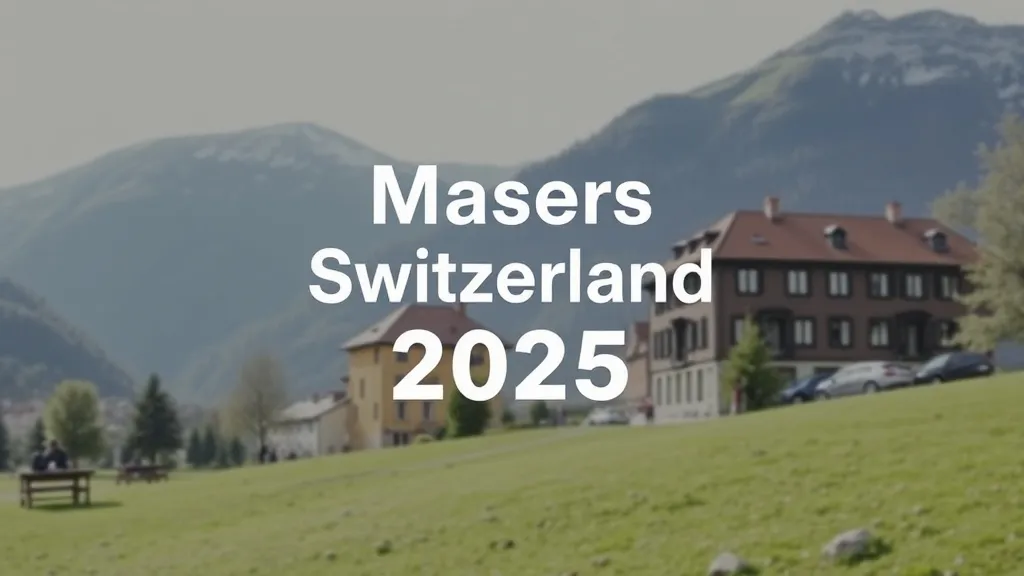
Masters Switzerland 2025: Graduate Guide
Agree: You’ve dreamed of advancing your career with a world-class degree. Promise: This guide unlocks everything about how to study in Switzerland masters programs in 2025—from top universities to scholarships and job prospects. Preview: You’ll learn why Switzerland stands out, which schools lead the pack, how to apply, funding options, and future trends (with plenty of real-world tips).
Interestingly enough, 19% of young adults in Switzerland held a master’s or equivalent degree in 2024, above the OECD average of 16%1. You’re in good company.
Table of Contents
Why Choose Switzerland for Your Master’s?
Ever wondered what makes Switzerland a magnet for postgraduate students? The truth is robust education, summer hiking trails, and a booming job market all play a part.
Studying in Switzerland offers:
- Top-ranked institutions with cutting-edge research.
- Multilingual campuses (German, French, English).
- Proximity to Europe’s biggest tech and finance hubs.
- Strong post-grad employment rates—unemployment sits at just 4.7% in 20252.
“AI is revolutionizing how companies operate… Master’s programs are adapting to equip students with these skills,” says a leading education analyst3.
So, why does it matter? In other words, your degree here carries global weight—and endless networking possibilities.
Actionable takeaway: List your top three career goals, then research which Swiss universities offer programs aligned with them.
Top Universities and Programs in 2025
Hook: Ready to compare schools? Let’s unpack the best spots for your master’s.
- ETH Zurich – Known for engineering, computer science, and natural sciences. Host to multiple Nobel laureates.
- École Polytechnique Fédérale de Lausanne (EPFL) – Leader in AI, robotics, and sustainable technologies.
- University of Zurich – Broad spectrum: from economics and law to biotech.
- University of Geneva – Strong in international relations, life sciences, and public policy.
- University of St. Gallen – Renowned for business, management, and ESG programs.
You might be wondering: which one fits you best? Consider campus culture, language of instruction, and program length (1–2 years).
Actionable takeaway: Visit each university’s official site and download program brochures for syllabi details.
Admission Requirements and Application Process
Hook: Missing one document can derail your dream—so let’s get it right.
Here’s a typical checklist:
- Bachelor’s degree transcript (min. GPA 3.0 or equivalent).
- Language proficiency (TOEFL/IELTS, or German/French tests if required).
- Statement of purpose and two academic references.
- CV highlighting research or internship experience.
- Standardized tests (GRE/GMAT) for some programs.
How to apply:
- Choose up to three programs—and note each deadline.
- Gather certified translations of transcripts (if needed).
- Submit applications via the university portal (make sure scans are clear).
- Schedule interviews or written assessments.
- Wait for your admission letter—then apply for a student visa.
Actionable takeaway: Create a timeline with key milestones—like exams, document translations, and visa interviews.
Financing Your Studies: Scholarships and Costs
Hook: Worried about steep Swiss living expenses? Let’s crunch the numbers.
Cost breakdown (per academic year):
- Tuition fees: CHF 500–2,000 (public universities).
- Accommodation: CHF 8,000–12,000.
- Living expenses (food, transport, insurance): CHF 15,000–18,000.
Scholarship sources include:
- Swiss Government Excellence Scholarships (SBFI).
- Erasmus+ Joint Master Degrees.
- University-specific grants (e.g., ETH Zurich Excellence Scholarships).
- Private foundations and industry partnerships.
“Switzerland encourages innovation—but you’ve got to back it up with a solid academic record,” notes a scholarship coordinator at EPFL.
Actionable takeaway: Apply to at least two funding sources—one competitive national scholarship and one university grant.
Career Prospects and Post-Grad Opportunities
Hook: What happens after you graduate? Big opportunities—if you play your cards right.
International graduates can stay up to six months to seek employment related to their studies2. And here’s the kicker: junior-level job postings jumped from 21% in 2019 to 28.8% in Q1 2025, especially in STEM and healthcare2.
Case study: Anna from Italy completed her MSc in Data Science at EPFL and now works as a machine-learning engineer at a Geneva biotech firm.
Actionable takeaway: Network relentlessly. Attend on-campus career fairs, join LinkedIn groups, and reach out to alumni via university career services.
Future Trends: AI and ESG in Swiss Master’s Programs
Hook: Curiosity alert—what’s next for master’s curricula?
Artificial Intelligence is reshaping master’s offerings, integrating machine-learning labs and ethics modules. Sustainability and ESG (Environmental, Social, Governance) criteria have become core to business degrees. In other words, programs evolve with industry demand.
Want to stay ahead? Look for interdisciplinary projects and labs focused on:
- AI for healthcare diagnostics.
- Green finance and impact investing.
- Smart manufacturing with IoT and robotics.
Actionable takeaway: During campus visits, ask faculty how they incorporate AI and sustainability into research projects.
FAQ
- What is the duration of master’s programs in Switzerland?
- Typically 1–2 years, depending on the field and institution.
- Can I work part-time while studying?
- Yes. International students may work up to 15 hours per week during term and full-time during breaks.
- Which language tests are accepted?
- TOEFL iBT, IELTS Academic, or institutional English tests; DELE for French/German programs if required.
- Are there student accommodation options on campus?
- Many universities offer dormitories, but demand is high—apply early or look for shared apartments off campus.
- What career services are available?
- Universities provide CV workshops, mock interviews, alumni networks, and job portals.
Conclusion
Summing up, Switzerland offers top-tier research universities, diverse programs, clear application steps, and strong funding opportunities—all wrapped in a stable job market. Whether you aim to lead in AI research or drive ESG initiatives, Swiss master’s degrees open doors.
Next steps:
- Identify your ideal programs and check specific admission dates.
- Prepare documents and apply for scholarships early.
- Engage with alumni and career services to map your post-grad path.
Ready to embark on your master’s journey? It’s your moment to shine in Switzerland’s innovative academic landscape. Study in Switzerland masters degrees await!