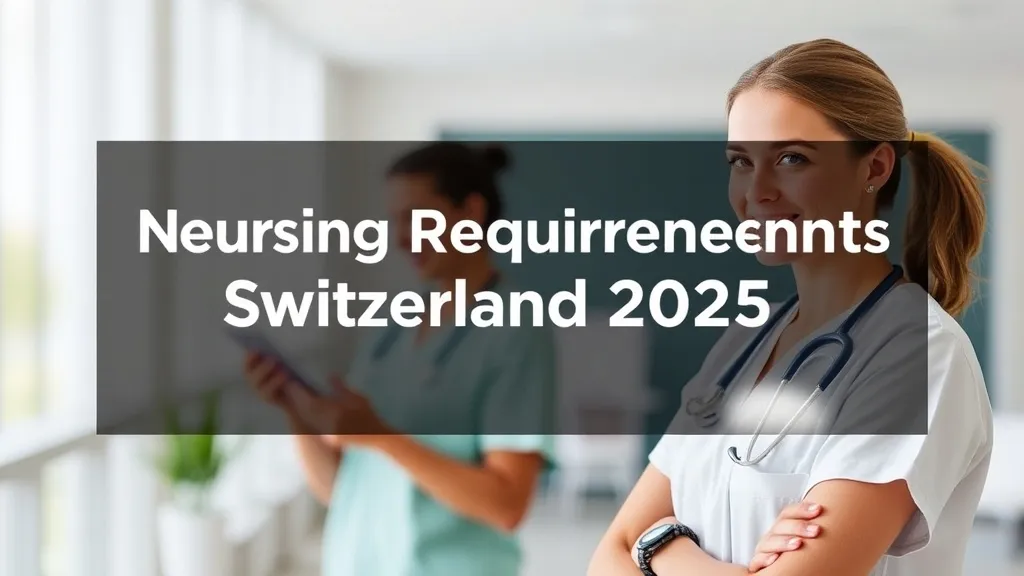
Nursing Requirements Switzerland 2025: Healthcare
You want clear, accurate guidance on the requirements to study nursing in Switzerland, right? You’re in the right place. By the end of this guide, you’ll know exactly what academic credentials, language tests, and regulatory steps are needed to start your nursing journey in 2025. You’ll also discover surprising trends—did you know over 50% of nursing leadership roles will demand advanced practice training by 2025?1 You’ll learn:
- Academic prerequisites and grade expectations
- Language proficiency tests in German, French or Italian
- Step-by-step application process
- Licensing and regulatory standards for 2025
Ready to dive in? Let’s get started.
Table of Contents
Academic Prerequisites for Nursing Studies
Imagine showing up on campus knowing your paperwork is flawless. That’s what meeting academic requirements feels like.
Secondary education is non-negotiable. Swiss institutions expect a completed high school diploma (Matura or equivalent) with a strong focus on biology, chemistry, and mathematics. International applicants often need credential evaluations to confirm equivalence.
Specific grade thresholds vary by canton, but most nursing programs require at least a 4.5 out of 6 (Swiss grading) or top 60% class rank. If you studied abroad, you may submit documents through Swiss ENIC-Doc for validation.
“Entry-level nursing education demands solid science foundations. Students lacking this often face remedial courses,” notes Urs Brügger, SAMW.2
Real Example: A student from Spain had to take an extra chemistry exam to bridge gaps before starting a Bachelor of Science in Nursing in Zurich.
Actionable Takeaway: Request your high school transcript evaluation six months before application deadlines to avoid delays.
Language Proficiency Requirements
You might be wondering: Do I really need fluency in a local language? The truth is, yes.
Most nursing programs are delivered in German, French, or Italian, depending on the region. Proof of proficiency is mandatory:
- German: TestDaF (level 4) or Goethe-Zertifikat C1
- French: DELF B2 or DALF C1
- Italian: CELI 3 or CILS B2
Interestingly enough, some schools accept prior education entirely in the target language as proof.
Example: A student educated in a French-speaking high school in Belgium bypassed the DELF exam requirement.
(Language skills matter beyond the classroom—they’re critical for patient safety.)
Actionable Takeaway: Schedule your language exam at least three months before the application cutoff to ensure results arrive on time.
Application and Admission Process
Here’s the thing—applications in Switzerland are decentralized. Each canton or institution sets its own deadlines and forms.
You’ll typically follow these steps:
- Submit online application with transcripts and translations
- Provide language certificates
- Complete an interview or entrance test
- Await decision and enroll
Most schools open applications in November and close by mid-February. Early bird advantage? Absolutely.
Case Study: An international applicant to Lausanne took the interview two weeks after applying but secured admission within a month, thanks to a well-prepared portfolio.
Actionable Takeaway: Create a checklist for each institution’s specific requirements to track documents, dates, and contacts efficiently.
Regulatory and Licensing Standards
Nursing in Switzerland is regulated by the Federal Office of Public Health (FOPH). You’ll need a recognized Bachelor of Science in Nursing to register.
By 2025, advanced roles like nurse anesthetists often require doctoral-level education—as highlighted by ICN and research. If you plan to pursue specialized tracks, anticipate additional exams or supervised practice hours.
Expert Insight:
“Advanced Practice Nurses play a crucial but still underdeveloped role in Swiss healthcare,” says Urs Brügger, SAMW.2
Actionable Takeaway: After graduation, apply for professional registration immediately through the FOPH portal to avoid lapses in clinical practice eligibility.
Program Structure and Duration
Bachelor’s programs run three years full-time, blending classroom theory with clinical rotations (900+ hours). Master’s tracks for healthcare leadership and advanced nursing roles add another 1–2 years.5
You might ask: Which specialization is right? Consider areas like pediatric care, gerontology, or anesthesia—each has unique entry conditions.
- Year 1–2: Foundational sciences and ethics
- Year 3: Intensive clinical placements
- Master’s: Research methods and leadership modules
Actionable Takeaway: Review the curriculum map of your chosen institution at nursing-education-basics to align electives with your career goals.
Career Prospects and Advanced Roles
Simply put, nursing in Switzerland offers diverse paths. From acute care to public health, opportunities abound.
Here’s a snapshot:
- Registered Nurse: Hospitals, clinics, home care
- Advanced Practice Nurse: Specialized clinical roles (growing demand)
- Healthcare Manager: Leadership positions with a Master’s5
The bottom line is, your nursing degree opens doors—and Switzerland’s aging population ensures sustained demand.
Actionable Takeaway: Connect with alumni via LinkedIn or alumni networks to learn about real-world career trajectories.
Conclusion
By now, you’ve got a solid roadmap for the requirements to study nursing in Switzerland. You know what academic credentials, language tests, and regulatory steps lie ahead. You also understand program structures, licensing standards, and future career prospects.
Next steps:
- Validate your high school diploma and secure certified translations.
- Register and prepare for the required language proficiency test.
- Create an application calendar noting deadlines and document checklists.
Ready to take that first step? Swiss nursing awaits, and your future patients thank you already.
FAQ
- What is the minimum GPA for nursing programs?
- Most require a 4.5/6 Swiss grading scale or equivalent—check each canton’s regulations.
- Can I apply in English?
- Applications can be in English, but you must prove proficiency in the program’s instruction language.
- How long does licensing take?
- FOPH registration usually takes 4–6 weeks after submission of all documents.