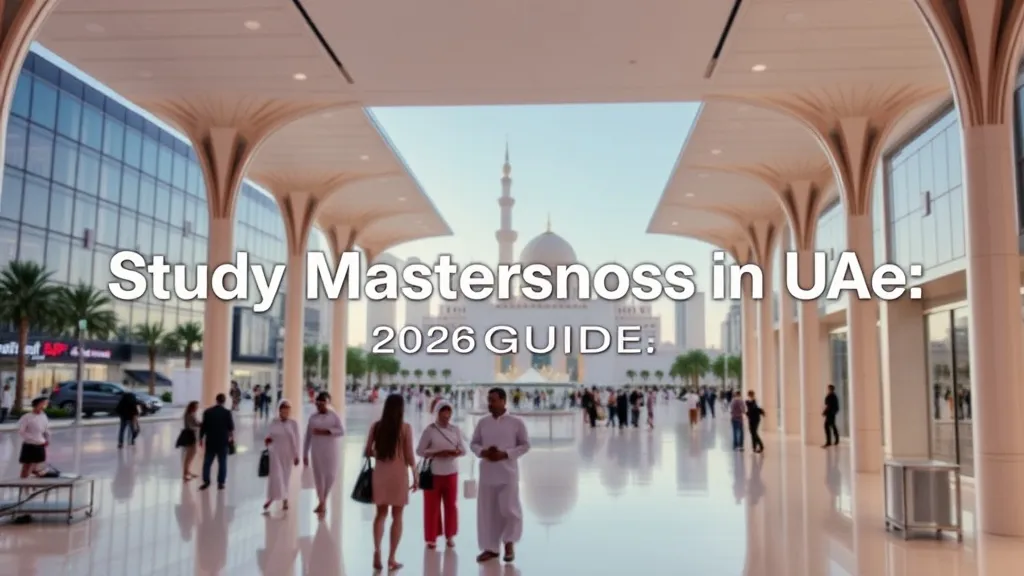
Study Masters Programs in UAE: 2026 Guide
You’re looking to study masters in UAE because you want top-notch education with global impact. Interestingly enough, the UAE plans to host over 20,000 international grad students by 2026—an impressive leap for any aspiring scholar (MOHESR). That said, the market is competitive. But here’s the thing: this guide helps you navigate master’s programs across leading universities, from application steps to scholarship tips. You’ll discover what makes the UAE a hub for innovation, especially in AI and data science. Let’s dive in.
Table of Contents
- Why Choose the UAE for Your Master’s Degree?
- Top Universities and Standout Programs for Fall 2026
- Navigating the Admission Process and Requirements
- Specializations and Emerging Trends
- Funding Your Master’s Journey
- Frequently Asked Questions
- What is the cost of living for a graduate student in the UAE?
- Can I work part-time during my master’s?
- How long does it take to process a student visa?
- Are courses taught in English or Arabic?
- Conclusion
Why Choose the UAE for Your Master’s Degree?
Imagine mixing futuristic cityscapes with academic excellence. The UAE offers just that—a vibrant environment where research meets real-world application. But why does this matter to you? For starters, Gulf universities rank among the fastest-growing research hubs globally.
Here’s the truth: a master’s from the UAE carries significant weight in Middle Eastern and international job markets. Plus, institutions often partner with Fortune 500 companies on cutting-edge projects. That’s not something every study destination can offer. You might be wondering what sets these programs apart.
- State-of-the-art campus facilities and labs
- Multicultural cohorts with global networking
- Strong industry collaborations and internships
- English-taught programs for wider accessibility
- A tax-free stipend potential in select scholarships
“The UAE’s vision for a knowledge economy makes it an ideal spot for graduate studies,” says Dr. Ahmed Al Mansouri, UAE Ministry of Education advisor.
Actionable takeaway: Start by listing fields that excite you most and match them with local industry trends. masters-programs-overview
Top Universities and Standout Programs for Fall 2026
Universities in the UAE are redefining graduate education. From specialized AI institutes to comprehensive research campuses, options abound. But how do you pick the best fit?
MBZUAI leads the AI charge with programs like Master in Applied Artificial Intelligence and MSc in Machine Learning. Early-decision applications open on 2025-09-01 and regular decisions close on 2026-04-30 (MBZUAI). Meanwhile, Zayed University and UAEU cover broader disciplines—engineering, business, education, law, and more.
- Mohamed bin Zayed University of AI: MSc in Computer Vision, Robotics
- Zayed University: MBA, MSc in Information Technology
- United Arab Emirates University: MSc in Renewable Energy, MSc in Cybersecurity
- Khalifa University: MSc in Data Science, MSc in Materials Science
Concrete example: A data science graduate from MBZUAI joined a global fintech startup in Dubai within two months of graduation—proof that program prestige can translate into career acceleration.
“Our graduates are shaping tomorrow’s AI solutions,” highlights Professor Philipp Slusallek, chief academic at MBZUAI.
Actionable takeaway: Shortlist three programs and schedule virtual campus tours to refine your options. admission-requirements-uae
Navigating the Admission Process and Requirements
Getting the prerequisites right often makes all the difference. Deadlines, transcripts, test scores—there’s a lot to juggle. But a clear roadmap eases the journey.
Most UAE universities require a bachelor’s with a 3.0 GPA or equivalent, English proficiency (IELTS/TOEFL), letters of recommendation, and a statement of purpose. Some programs request GRE/GMAT scores. Visa applications can take 4–6 weeks, so plan accordingly.
- Prepare transcripts and translations early
- Secure recommendation letters from academic or industry mentors
- Draft and revise your statement of purpose (make it personal)
- Apply for scholarships alongside your program application
Here’s a timeline example for Fall 2026 at MBZUAI:
- 2025-09-01: Early decision opens
- 2025-11-15: Early decision deadline
- 2026-04-30: Regular decision deadline
- 2026-06-15: Final offers released
Actionable takeaway: Create a shared spreadsheet to track each application component. scholarships-masters-uae
Specializations and Emerging Trends
AI, data science, and sustainability aren’t just buzzwords—they’re shaping UAE’s research landscape. But which area aligns with your goals?
Consider these fast-growing fields for master’s research in 2026:
- Artificial Intelligence and Machine Learning
- Data Science and Big Data Analytics
- Renewable Energy and Environmental Engineering
- Cybersecurity and Information Assurance
- Business Analytics and Fintech Innovations
“Demand for data scientists in the Gulf has grown by over 45% since 2022,” reports GulfTalent insights.
You might be wondering: how do research-based theses work here? Typically, you’ll spend six weeks in an industry internship and complete a 36-credit thesis project under a faculty mentor.
Actionable takeaway: Reach out to current students on LinkedIn to discuss their thesis experiences.
Funding Your Master’s Journey
Tuition can be steep, but funding options abound. From full-ride scholarships to part-time research assistantships, there’s financial support for motivated candidates.
- Government Scholarships: UAE National Research Foundation grants
- University Fellowships: MBZUAI AI Fellowships, UAEU Graduate Scholarships
- External Awards: Chevening, Fulbright, Erasmus Mundus partnerships
- Employer Sponsorships: Local and multinational firms often sponsor staff studies
- Why UAE: Research growth, industry ties, global networks
- Top Picks: MBZUAI, Zayed University, UAEU, Khalifa University
- Process: GPA, English tests, recommendations, SOP
- Trends: AI, data science, sustainability
- Funding: Government, university, external, employer
Frequently Asked Questions
What is the cost of living for a graduate student in the UAE?
Expect living expenses between AED 4,000–8,000 per month, including housing, food, and transport. Dubai tends to be pricier than Abu Dhabi.
Can I work part-time during my master’s?
Yes—most student visas permit up to 20 hours of on-campus work weekly. Off-campus roles require special permits.
How long does it take to process a student visa?
Visa processing ranges from 4 to 6 weeks after your university issues the admission letter. Apply early to avoid delays.
Are courses taught in English or Arabic?
Nearly all master’s programs in leading UAE universities are offered in English to cater to international cohorts.
Conclusion
Studying a master’s in the UAE offers you unparalleled industry links, cutting-edge research, and a gateway to global careers. You’ve learned the why, where, and how—from top institutions to funding pathways, from admission timelines to specializations. Now it’s your move.
Here are three next steps:
- List your top three program choices and mark application deadlines in your calendar.
- Gather transcripts, test scores, and recommendation letters well in advance.
- Apply for scholarships as soon as applications open to boost your chances.
The bottom line is: preparation breeds confidence. Your decision to study masters in UAE could be the turning point in your academic and professional journey. So go ahead—start that application today and step into a future you’ve always imagined.